


What Is The Difference Between Crepe Bandage And Elastic Bandage?
Views: 0 Author: Site Editor Publish Time: 2026-06-22 Origin: Site


Choosing the wrong medical supply carries serious consequences. An incorrect bandage selection can lead to improper healing. It can restrict circulation or damage vulnerable skin. Many individuals conflate different wrap types. They view them all as general compression wraps. However, their material composition dictates entirely different uses. Their clinical mechanisms of action separate these products sharply. You need to know these fundamental differences. This article provides a clear, evidence-based evaluation framework. We aim to help clinicians, procurement teams, and patients. You will learn to select the correct bandage confidently. We cover critical support requirements, material science, and patient safety. Proper knowledge prevents secondary injuries. It ensures faster rehabilitation and better clinical outcomes.
Key Takeaways
Material Composition: A Cotton Crepe Bandage relies on woven yarn textures for mild stretch, whereas elastic bandages utilize synthetic rubber or polyurethane core threads for high-tensile stretch.
Compression Levels: Elastic bandages deliver heavy, sustained compression ideal for acute trauma; crepe bandages provide moderate, breathable support for post-operative care and light sprains.
Skin Integrity: Crepe is highly breathable and minimizes maceration; elastic can trap heat and moisture during prolonged wear.
Reusability: Elastic bandages maintain structural memory longer under heavy use, while crepe is often preferred for shorter-term or single-patient applications.
The Baseline Definitions: Composition and Mechanisms of Action
The Anatomy of a Crepe Bandage
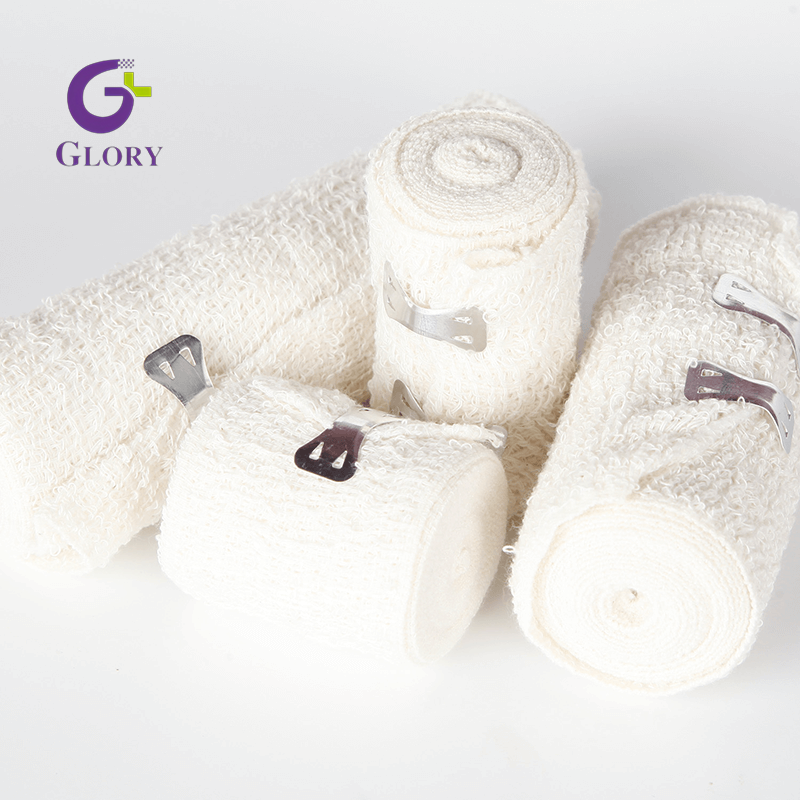
Let us examine how a Crepe Bandage actually functions. It achieves elasticity without using synthetic rubber. Instead, manufacturers tightly twist cotton or cotton-blend yarns. This unique weaving process generates a natural mechanical yield. When you pull the fabric, the twisted fibers straighten. When you release it, they coil back gently.
The Cotton Crepe Bandage variation is highly popular globally. We emphasize its 100% natural fiber composition. This pure construction ensures excellent hypoallergenic properties. Patients benefit from superior breathability during recovery. The mechanism of action remains very gentle. It provides localized warmth to injured tissues. It delivers mild-to-moderate support. Crucially, it secures the area without constricting vital blood flow.
Best Practices for Application
Always unroll a few inches before applying to the skin.
Use a spiral or figure-eight wrapping technique.
Ensure overlapping layers cover half of the previous layer.
The Anatomy of an Elastic Bandage
Elastic bandages operate on a completely different structural mechanism. Manufacturers construct them by integrating woven cotton or polyester. They combine these fabrics alongside synthetic active fibers. You will typically find elastane, latex, or rubber threads inside. This synthetic core provides immense tensile strength. It creates a powerful, rubber-band effect across the fabric.
The mechanism of action relies on active pressure. It delivers graduated compression to injured areas. Clinicians use it to forcefully reduce edema or swelling. These wraps also immobilize joints very effectively. The aggressive stretch requires careful handling. Untrained users can easily pull the synthetic fibers too tight.
Core Evaluation Dimensions: Matching Features to Patient Outcomes
We must compare these tools across critical performance metrics. You must match the right physical feature to your patient's specific needs. Below, we break down three core evaluation dimensions.
Stretch and Retraction Profiles
Elastic options offer incredibly high extensibility. They often stretch beyond 150% of their original resting length. They also provide aggressive, snapping recoil. This makes them critical for acute R.I.C.E. protocols. You need this aggressive recoil during early injury stages. It pushes excess fluid away from the trauma site.
Conversely, crepe options offer limited, yielding stretch. They conform smoothly to difficult body contours. You can wrap irregular joints like knees or ankles easily. They secure primary dressings safely. They conform without applying dangerous levels of localized pressure over bone prominences.
Breathability and Tissue Health
Crepe materials offer exceptional vapor permeability. Air flows freely through the woven cotton structure. This reduces the risk of contact dermatitis significantly. You also minimize tissue maceration during prolonged wear. Patients can wear them comfortably in warmer climates.
Elastic materials have much lower air permeability. The dense synthetic rubber blocks normal airflow. You must carefully monitor the patient's skin. Extended recovery periods can trap excess heat and moisture. This trapped moisture often causes skin irritation or rashes.
Durability, Sterilization, and Compliance
We must evaluate general product lifecycles. Elastic wraps generally survive more heavy wash cycles. Their synthetic core retains tensile strength remarkably well. They bounce back even after severe stretching.
Compliance factors shift the balance toward natural fibers, however. Sterile clinical environments often prefer crepe options. Single-use or specialized autoclaving protocols demand reliable, degradable materials. Using fresh, single-patient crepe wraps minimizes cross-contamination risks effectively. They break down safer and align with infection control protocols.
Clinical Comparison Chart
Feature Dimension | Crepe Wrap | Elastic Wrap |
|---|---|---|
Stretch Capacity | Mild to Moderate (Yielding) | High (150%+ with strong recoil) |
Breathability | Excellent (High vapor permeability) | Low to Moderate (Traps heat) |
Primary Function | Dressing retention, light support | Edema reduction, firm immobilization |
Skin Safety | Hypoallergenic, safe for fragile skin | Monitor for maceration or latex allergies |
Clinical Use Cases: Which Solution Solves Which Problem?
Selecting the proper wrap dictates overall recovery speed. Let us look at specific clinical scenarios. You will understand exactly when to deploy each option.
When to Deploy an Elastic Bandage
You should deploy synthetic elastic wraps for severe, immediate trauma. They provide the necessary force to control rapid swelling.
Acute sports injuries. Use them for Grade 2 or 3 sprains and muscle strains. The strong recoil supports damaged ligaments.
Lymphedema management. They assist venous leg ulcer protocols. They push fluids back toward the heart. Always do this under strict medical supervision.
Immediate swelling control. Use them when you require aggressive edema reduction. They are vital in the first 24 to 48 hours post-injury.
Common Mistake: Leaving a high-stretch wrap on while the patient sleeps. This practice can cause severe circulatory issues overnight. Patients should typically remove them before bed.
When to Standardize on a Crepe Bandage
Many hospitals standardize on a Crepe Bandage for healing stages. They excel when aggressive compression is no longer required.
Post-operative wound dressing retention. They hold surgical gauze securely. They do this without cutting off fragile capillary circulation.
Rehabilitation joint support. They help during later stages of recovery. A Grade 1 sprain benefits from this yielding warmth.
Sensitive patient care. Use them for geriatric patients. They are perfect for individuals possessing fragile, elderly, or highly reactive skin.
Best Practice: Check the bandage tension by sliding two fingers under the fabric. If your fingers fit snugly but comfortably, the tension is correct.
Implementation Risks and Contraindications
Both products carry distinct, serious clinical risks. You must understand their contraindications thoroughly. Misapplication leads to dangerous complications.
The Dangers of Over-Compression (Elastic)
Untrained users often wrap elastic bandages much too tightly. This triggers severe clinical emergencies. Compartment syndrome is a major danger. This occurs when pressure builds up within muscle tissues. Peripheral neuropathy can develop quickly from pinched nerves. Arterial occlusion might occur if blood flow completely stops.
Pay close attention to contraindications. Never use high-stretch elastic over un-diagnosed fractures. You might displace the broken bone fragments further. You must also avoid it if the patient has advanced peripheral arterial disease (PAD). Their compromised blood flow cannot handle extra surface pressure.
Limitations of Support (Crepe)
A Cotton Crepe Bandage possesses its own inherent limitations. The main clinical risk is inadequate edema control. They simply cannot handle severe trauma swelling. Their twisted yarns will yield to the swelling pressure.
Identify their clinical contraindications clearly. They are never a valid substitute for rigid immobilization. Do not use them instead of fiberglass splints or plaster casts. They also fail completely as high-grade compression therapy for chronic venous insufficiency.
Decision Framework for Shortlisting and Procurement
You need a clear decision framework for medical inventory. Clinics and hospitals must align their purchases with actual patient needs.
Assess the Primary Clinical Intent
Ask yourself about the main therapeutic goal. Is the primary goal active compression? If so, choose the synthetic elastic variant. Is the goal dressing retention or mild, warm support? If yes, choose the woven crepe variant. This simple question solves most procurement debates.
Evaluate Patient Demographics
Factor in skin sensitivities immediately. Look closely at your facility's patient allergy profiles. Latex allergies present a massive liability risk. You must source explicitly latex-free elastic wraps. Alternatively, default to a pure natural fiber wrap. This provides total safety for unknown allergy statuses.
Inventory Scalability and ROI
Consider your specific healthcare facility environment carefully.
High-turnover first-aid stations benefit from crepe. Surgical wards also use them extensively. Bulk-purchasing highly conformable crepe wraps offers excellent inventory efficiency.
Athletic training rooms need rugged durability. Physiotherapy clinics also require reusable supplies. Investing in highly durable, washable elastic bandages provides better long-term usage value.
Stocking a balanced mix prevents clinical delays. Ensure nurses always have access to both distinct profiles.
Conclusion
Neither bandage type is universally superior to the other. Their efficacy depends entirely on matching material properties to clinical needs. You must align mechanical stretch limits with patient requirements. Using high-compression wraps for delicate surgical dressings harms the patient. Using yielding cotton weaves for acute trauma fails to stop swelling. We recommend stocking an appropriate ratio of both supplies. Keep them clearly separated in your medical kits. Reserve the aggressive elastic variants for acute trauma management. Deploy gentle crepe variants for post-operative care and sensitive skin. Direct your procurement managers to review your current inventory mix today. Consult product safety data sheets closely. Finally, request specification samples from your medical supplier to ensure optimal patient care.
FAQ
Q: Can I sleep with a Crepe Bandage on?
A: Yes, it is generally safe to sleep wearing one. They provide mild, yielding compression. You must ensure it is not wrapped too tightly. In contrast, you should typically remove elastic bandages at night. Only keep elastic wraps on overnight if specifically prescribed by your doctor.
Q: How do you wash and reuse a Cotton Crepe Bandage?
A: You should hand wash them carefully. Use lukewarm water mixed with a mild detergent. Do not wring or aggressively scrub the fabric. After washing, dry the wrap flat on a clean surface. Never stretch it while drying. This maintains the essential twisted-yarn elasticity.
Q: Are crepe bandages latex-free?
A: Most 100% cotton variants are naturally latex-free. This makes them the standard choice for strict hypoallergenic compliance. Conversely, elastic bandages often contain synthetic rubber or latex threads. You must explicitly verify elastic variants as latex-free by checking the manufacturer's official packaging label.
Q: When should I stop using an elastic bandage and switch to a crepe bandage?
A: You should initiate the transition phase once acute swelling subsides. This usually happens after 48 to 72 hours. At this point, your clinical goal shifts. You no longer need aggressive edema management. You transition to providing light, comfortable mobility support for the healing joint.
